.png?width=160&height=42&name=logo_color_Tag3%20(1).png "Return to Innervate homepage")

I’ve been in digital production long enough to remember when “scaling a campaign” was a test of physical and mental endurance. It meant manually exporting the same video fifteen different ways—fiddling with aspect ratios, fighting with codecs, and praying that nothing broke during the upload.
Back then, we didn't call it creative work; we called it the cost of doing business. We just accepted the friction.
Then AI arrived, and the conversation shifted almost exclusively to speed. Faster content, faster iterations, faster everything. But here’s the reality: speed was never our real problem. The problem is that the systems underneath our production were never designed to scale in the first place. AI didn’t fix that—it just stripped away the illusion that our old workflows were actually working.
The Illusion of Efficiency
If you zoom out, most production workflows haven’t fundamentally changed in a decade. We still move linearly from brief to build, then to versioning, trafficking, and finally reporting, with a massive amount of manual effort stitching the gaps together. Our tools got shinier, but the system stayed the same.
What AI did was pour gasoline on that fragile structure. Suddenly, instead of ten variations, you can produce a hundred. Instead of testing two ideas, you can test every whim. That sounds like a dream until you realize a hard truth: If your workflow can’t handle ten versions cleanly, it has no business attempting a hundred.
When you scale a broken process, you don't get efficiency; you get creative chaos. You end up with more assets, more fragmentation, and teams spending 90% of their time managing outputs instead of actually improving the work. AI didn’t create this inefficiency—it just scaled it.
The Shift We Weren't Prepared For
The real transformation happening right now isn’t about content generation; it’s about a fundamental shift in what our job actually is. Creative production is moving away from "crafting outputs" and toward "designing systems."
This requires a complete mental pivot. We have to start thinking in terms of:
- Components instead of finished, static assets.
- Flows instead of rigid, linear steps.
- Feedback loops instead of post-mortems.
The questions we’re asking are changing, too. It’s no longer just "What should this ad look like?" It’s "How does this idea adapt across TikTok, YouTube, and OOH without being rebuilt from scratch?" or "How does performance data automatically trigger the next iteration?" Most teams don't have the answers yet, which is why AI feels like a miracle in a demo but a headache in daily practice.
What Actually Moves the Needle
There is a lot of noise right now about "AI skills," but knowing how to write a clever prompt isn't going to save your agency. The real competitive advantage belongs to the teams who understand the plumbing:
- Structuring content so it’s flexible across every format.
- Connecting creative to data in real-time, not weeks after the fact.
- Automating the movement of content, not just the creation of it.
None of this is particularly "new" technology, but it has finally become unavoidable.
The Missing Link: Connectivity
I see the same pattern everywhere: a brand invests in AI tools, generates a mountain of content, runs a few pilots, and then… nothing happens. The needle doesn't move.
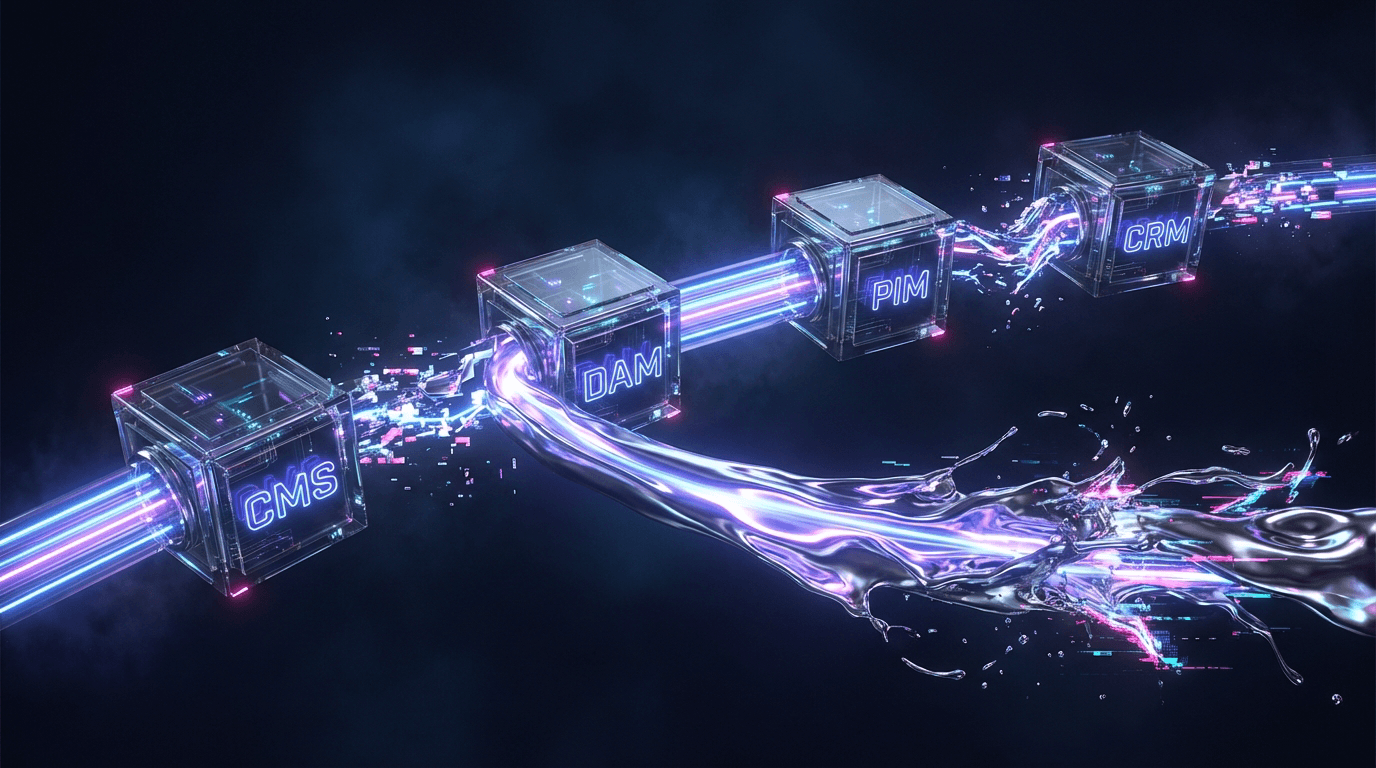
This happens because the underlying systems remain disconnected. Creative lives in one silo, assets in another, media in a third, and data in a fourth. Without a connective layer, AI outputs just sit there—detached from the workflow that gives them value.
This is exactly why we built Innervate. We don’t view AI as another layer to add to your tech stack; we view it as the connective tissue that your stack is missing. By linking your existing systems, content can actually move, adapt, and scale across channels as a unified flow.
Breaking "Creative Gravity"
For most of my career, the hardest part of the job wasn’t coming up with the "big idea"—it was the "creative gravity." It was the sheer weight of production, the friction between tools, and the time required to execute.
AI is breaking that gravity, but not by replacing the artist. It’s forcing us to modernize the infrastructure of creativity. The teams that win won't be the ones with the best prompts; they’ll be the ones who built the workflows that can actually handle the output.
We’re moving into a world where campaigns don’t "end"—they adapt and respond in real-time. That’s a massive opportunity, but only for those who are willing to fix the plumbing first.