.png?width=160&height=42&name=logo_color_Tag3%20(1).png "Return to Innervate homepage")

Look, I get the hype around Generative AI. After nearly two decades in this industry—starting as a designer and now leading creative at Innervate—I've seen plenty of "next big things." But GenAI? It actually delivers. It writes, it designs, it cranks out assets faster than any team I've ever managed.
The stats tell the story:
-
88% of marketing professionals saw content demand at least double in the last two years, projecting 5x–20x growth ahead1
-
Deloitte Digital reports companies are expecting to accelerate production and revenue impact with GenAI2
-
95% of executives believe GenAI will be a game changer, according to IBM Institute for Business Value1
So yeah, GenAI matters.
But here's what I've learned watching teams implement it: it doesn't fix your broken systems. It just makes the cracks more obvious.

GenAI Is Great at Starting Things
(But That's It)
GenAI excels at fast ideation, first drafts, quick asset generation, and early-stage production. Deloitte's research backs this up—it accelerates creative development, reduces manual grunt work, and increases output. That's genuine value.
But it comes with real risks:
-
High brand risk – It's unconstrained, so off-brand content slips through
-
High compliance risk – Unreviewed claims that could land you in hot water
-
Heavy review burden – Every output needs full legal and brand oversight
Here's the thing nobody talks about: automation amplifies whatever system you put it into.
IBM's research is blunt—most content supply chains are already fragmented, siloed, and lacking governance. IBM found that only 5% of organizations have a mature governance model for GenAI1.
So what happens when you drop GenAI into that mess? You get more versions floating around, more approval bottlenecks, more brand inconsistency—more chaos, just at light speed.
We're Solving the Wrong Problem
After working in creative for this long, I can tell you: the problem was never "we can't create enough stuff."
The real problem? We can't manage, adapt, and deploy what we already have.
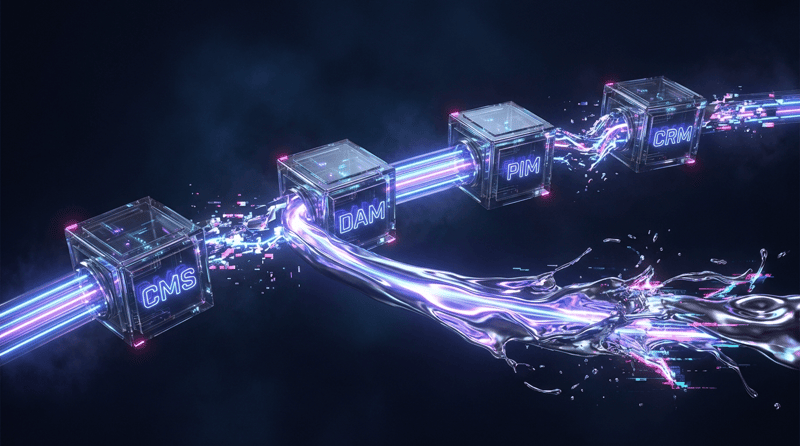
Most organizations are running on siloed teams, disconnected tools, manual handoffs, and assets locked into specific formats.
IBM's data proves the point:
-
75% of organizations struggle to deliver consistent experiences across channels1
-
89% desperately need better access to reusable content1
GenAI doesn't solve that bottleneck. It floods it.
ReGen AI: The Shift from Creation to Orchestration
This is where things get interesting—and where my perspective at Innervate has completely shifted.
ReGen AI flips the whole model. Instead of starting from scratch every time, it starts with your structured, approved content—the stuff that's already been through legal, brand review, compliance, all of it.
Here's the key difference:
-
GenAI = generate more content from nothing
-
ReGen AI = unlock massive value from what you already own
And the risk profile changes completely:
-
Lower brand risk – You're working from approved assets, not AI guesswork
-
Lower compliance risk – You're reusing statements that have already been vetted
-
Moderate review burden – You only need to review variants, not start from scratch
How ReGen AI Actually Works
ReGen AI:
-
Breaks approved assets into modular components – headlines, images, CTAs, metadata
-
Maps those components to channel-specific templates – TikTok, display ads, email, CTV
-
Rebuilds content for each platform – not just resized, but reconstructed for context
-
Keeps brand and compliance intact – working from pre-approved source material
-
Deploys everything instantly – eliminating production lag
This isn't content creation. This is content infrastructure.
Most marketing budgets aren't eaten up by big ideas. They're devoured by reformatting, resizing, rebuilding, and re-approving—over and over again.
ReGen AI eliminates that loop entirely. One Facebook ad becomes TikTok, display, and email in hours—not weeks. Same idea. Zero reinvention.
Why ReGen AI Wins: It's Not Even Close
Let's be honest—these aren't comparable tools. They operate at completely different layers:
|
Dimension |
GenAI |
ReGen AI |
|
Starting Point |
Blank slate |
Approved content |
|
Output |
Net-new assets |
Scaled variants |
|
Brand Risk |
High (unconstrained) |
Low-Medium (constrained) |
|
Compliance Risk |
High (unreviewed) |
Lower (pre-approved) |
|
Review Burden |
Full legal/brand oversight |
Variant review only |
|
Best For |
Ideation, new concepts |
Scaling, localization, personalization |
Here's the underlying truth: GenAI predicts outputs. It doesn't verify truth, which is why hallucinations and off-brand content happen.
ReGen AI avoids that entirely. It doesn't guess. It rebuilds from approved reality.
How Innervate Helps Clients Scale Smarter
Most companies try to layer GenAI on top of broken workflows. That's like putting a turbo engine in a car with no transmission—impressive for about six seconds.
At Innervate, we take a different approach. We focus on Dynamic Content Orchestration—connecting content, data, AI, and execution into a unified, responsive system. Not another tool. Not better prompts. A system where content is modular, data is active, AI is constrained, and execution is automated.
What Our ReGen AI Tools Do
We help clients:
-
Scale creative without reinventing it – Take your approved assets and regenerate them across channels instantly
-
Reduce review burden – Work from compliant source material, so you're reviewing variants, not starting over
-
Automate campaign trafficking – Deploy multi-channel campaigns from a single approved asset
-
Improve reporting and insights – Track performance across all regenerated variants from one unified view
-
Maintain brand consistency at scale – Every output is constrained by your approved content and brand guidelines
Instead of "here's more content, good luck managing it," our clients get:
-
One asset → infinite compliant variations
-
One workflow → multi-channel execution
-
One system → full lifecycle control
That's not a feature. That's leverage.
Real Results We're Seeing
The clients we're working with at Innervate aren't just moving faster—they're fundamentally changing how their marketing operations work.
We're seeing:
-
Drastically reduced campaign launch times – because teams aren't rebuilding assets for every channel
-
Review cycles shortened dramatically – legal and compliance teams only need to review the original, not for every variant
-
Accelerated multi-market rollouts – localization and personalization at scale
-
Creative teams freed up to do actual creative work – instead of endless reformatting
That's the shift ReGen AI enables.
Know When to Use Each
Here's my honest take after watching both technologies in action:
Use GenAI when you need:
-
Fresh concepts and new campaign ideas
-
Brainstorming and exploration
-
Quick mockups for pitch decks
-
Early-stage creative development
Use ReGen AI when you need:
-
To scale campaigns across channels
-
Multi-market or localized variations
-
Personalization at scale
-
Fast deployment with compliance confidence
-
To actually hit your trafficking and reporting deadlines
The companies winning right now? They're using both—but they understand the distinction.
GenAI helps you start. ReGen AI helps you scale.
The Bottom Line
I've been in this industry long enough to know when something is actually transformative versus just trendy.
ReGen AI isn't replacing GenAI. It's solving the problem GenAI creates—the operational chaos that comes from generating content without a system to manage, deploy, and measure it.
Content demand is exploding. Budgets are shrinking. Teams are already overloaded. So the winning strategy isn't "create more content faster." It's: "Extract more value from what already exists."
The brands that figure this out early won't necessarily be the loudest about it. They'll just quietly outperform everyone else—shipping campaigns faster, maintaining brand consistency, staying compliant, and actually using their creative teams for creative work.
If you're struggling with creative ad scaling, campaign trafficking, cross-channel deployment, or just drowning in content that never makes it to market—let's talk. At Innervate, we're building ReGen AI tools specifically designed to turn your approved content into a scalable, orchestrated system.
Because the future isn't about making more content.
It's about making your content work harder.
Want to see how ReGen AI can transform your content operations? Contact us or reach out directly—I'd love to show you what's possible.
Sources
[1] IBM | The revolutionary content supply chain (2024)
[2] Deloitte | The marketer’s guide to Generative AI in the content supply chain (2024)