.png?width=160&height=42&name=logo_color_Tag3%20(1).png "Return to Innervate homepage")

Ask an agency leader if AI is going to significantly impact their business–you’ll get a clear, fast answer.
But ask them if their agency is ready to successfully scale it? That’s a different story.
The current state of AI in creative operations isn’t the utopian future-state it’s pitched to be…yet. It raises questions of risks, rework, debatable quality, and agency infrastructure that usually wasn’t built with AI in mind.
We partnered with NewtonX to survey 100 leaders at independent agencies to find out. We wanted to get their direct perspective on the current vs future state of AI in creative operations: how they’re currently using AI, how successfully it’s performing, and what they foresee in their AI-future. 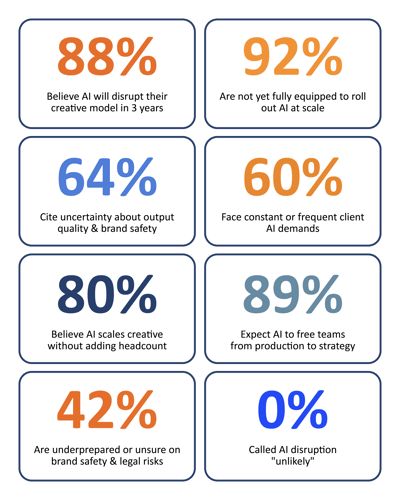
According to the findings, the potential of AI is clear, but it’s going to take some serious work to bridge the gap from current to ideal state. 88% of agency leaders believe AI will fundamentally disrupt their creative business model within 3 years. Only 8% feel fully equipped to handle it.
Brand safety & output quality are the top barrier to deeper AI adoption
We asked what’s stopping agencies from expanding AI adoption in creative operations.
The answer wasn’t cost or client resistance, or even demonstrating ROI.
It was uncertainty about AI-output aligning with brand safety and/or quality standards.
We asked directly how prepared agencies felt managing the legal & brand-safety risk that comes with AI-generation, only 10% felt they were fully prepared.
Drilling down into the segments, we found that C-suite leaders are most convinced significant disruption is coming, but feel the least prepared for it. They posted the highest disruption-expectation score in the entire survey (4.47 out of 5) but, at the same time, the lowest brand-safety-preparedness score of any seniority level (3.11 out of 5). For context, no other job title or seniority segment averaged higher than 3.6 out of 5.
The editing tax: AI drives fast output…and rework
In the write-in section, we asked what is stopping agencies from scaling AI in creative production. Over 1 in 4 (27%) bluntly called out the same problem: AI results that are off-brand/off-brief, unreliable, or low quality to the point that heavy human rework is needed.
One VP of Marketing put it plainly: “AI generates volume, but it misses nuanced brand voice and compliance guardrails — so teams spend nearly as much time editing and aligning outputs as they would creating from scratch.” A Creative Director wrote something similar: “the review and correction work needed to align AI output with client standards is eating the efficiency gains that were supposed to be the whole point.”
That’s a key theme running the span of the report. AI isn’t eliminating labor in creative production. At least not yet. For many, it’s merely moved from making things to fixing things.
Too many tools; not enough structure
A big part of why there’s so much fixing to do: 56% of agencies are running 3+ different approaches to AI at once (embedding into existing tools, using third-party platforms, stitching together point solutions, and/or building proprietary capability in-house). That’s what we call a Frankenstack…and it usually spells trouble for any org with dreams of seamless integration, full-proof workflows, and automated processes (that actually work).
Only 8% said they have a coordinated approach that's actually working at scale.
One VP called out "uncertainty about which tools to use amongst the glut of tools being rolled out week by week" as their single biggest challenge in using AI to scale creative production.
And more tools = more skills & expertise needed
63% of respondents cited lack of internal expertise or training as a top barrier to deeper adoption, coming in a close 2nd place to brand safety and quality concerns. Separate tools often call for separate experts, who then need to keep up with the feverish pace of evolving AI solutions.
One CMO wrote that a genuinely valuable solution would need to be: “Easy to learn, re-skill/upskill, and support/guidance in workflow process changes and change management.”
Point blank: What do agency leaders actually want?
We got straight to the point and asked respondents what would actually need to be true about an AI-powered creative operations solution for them to genuinely feel confident adopting it. About 28% mentioned data protection and legal/IP clarity, while over a quarter brought up brand governance, guardrails, and consistency that's built in, not bolted on. Seamless workflow integration came in third.
And the write-in responses were clear:
“Clear governance, strong IP and data protections, and confidence the outputs consistently meet brand and creative standards - and it needs to integrate into existing workflows” wrote one Senior Director.
A CMO wrote: “For me to feel genuinely confident adopting an AI solution, it would need to be sophisticated in the way it receives and stores inputs like SOPs, guidelines, and guardrails—and consistently output results based on those inputs.”
An editorial director said: “If it can be trained accurately about our specific brand and our existing previous work. This would help to give the AI work more of a personal ‘us’ feeling.”
And a VP called out that “It would need to allow collaboration and access to MANY team members across roles and permission sets. Would also need to be able to connect to a variety of tech stacks / inputs.”
Read those together and the ask is pretty clear: agencies don't want another tool that generates faster. They want infrastructure that's accountable by design — governance and guardrails as natively built into the solution foundation, not tacked on as an afterthought.
The agencies that close the gap from AI ambition to AI readiness will win
Nearly every agency in this study is already living the paradox: big change is coming, but no one feels fully prepared for it. And building the plane while it’s in flight has, in some cases, caused a bigger headache than pre-AI work.
The winning agencies won’t be the first to adopt AI. It’ll be the ones that closed the readiness gap by accounting for governance, training, and building a strong foundation for their AI future. They’ll be the ones focusing on making sure AI output that a client can actually trust, not just something fast. That's a harder thing to build than a tool stack. It's also the thing clients are actually asking for.
You can read the full AI-Readiness in Independent Agencies report, including the complete data set and agency leaders' own words, at www.innervate.com/agency-ai-benchmark-report-2026.